Conejos River Colorado Fishing Report: Flows & Trout Access
The Conejos River can be excellent trout water, but it is not a “show up anywhere and fish however you want” stream. Flow changes, easement boundaries, artificial-fly-only rules and section-specific access all matter.
This guide gives you the practical workflow: check the CPW special regulations, confirm Mogote flows, pick the right public access, and use local trout tips that actually fit the Conejos.
Last reviewed: June 24, 2026. Verify CPW rules, Colorado DWR/USGS flow information, Forest Service access and posted easement signs before fishing.
Quick Answer: Is the Conejos River Good for Trout Fishing Right Now?
Usually yes, if flows are reasonable and you fish the right section legally. The smartest workflow is simple: check the Conejos River CPW page, confirm the current Mogote flow trend, then match your access point and flies to the day’s conditions.
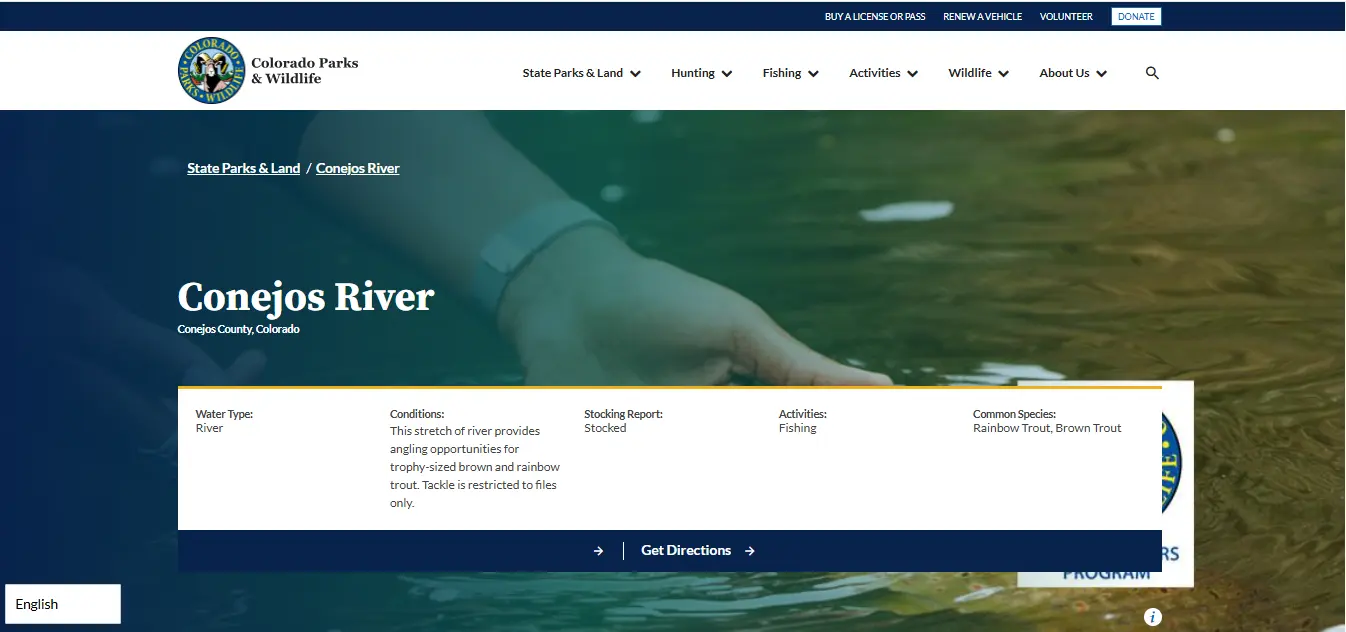
The CPW Conejos River page highlights public fishing easements in the Bear Creek and Sheep Creek subdivisions and lists special regulations that include artificial flies only and a trout bag/possession limit of two fish with a 16-inch minimum size for that regulated section.
Rule check first
Do not assume the whole river fishes under generic trout rules. Read the special-regulation wording before you tie on flies.
Flow check second
If flows are high or dirty, the fishing plan changes. If flows are low and clear, stealth matters much more.
Access matters
Use public easements, Forest Service areas and legal trail access only. Do not confuse a visible riverbank with legal permission.
Screenshot Guide: Official Conejos River Fishing Rules Page
This screenshot is placed near the start so readers can quickly recognize the official CPW Conejos River page before opening the live rules and access notes.
Watch First: Conejos River Fly Fishing & Access Video
This local-style video gives readers a visual feel for the Conejos River, trout water type and access environment. Use it for context only, not as a legal rule source.
Conejos River Rules: The Practical Version
The Conejos River is not hard because the rules are long. It is hard because anglers often ignore section-specific rules and private-land limits. The CPW page gives the key guardrails.
| Rule Area | Official Summary | What You Should Do |
|---|---|---|
| Public access easements | CPW highlights fishing easements in the Bear Creek and Sheep Creek subdivisions. | Use those easements carefully and stay inside legal access boundaries. |
| Fly rule | Fishing by artificial flies only in the special-regulations section shown on CPW. | Leave bait and conventional hardware out of that regulated stretch unless you verify a different legal section. |
| Trout bag/possession | Two trout in the special-regulations section. | Count carefully and do not assume a generic statewide trout number applies there. |
| Minimum size | 16-inch minimum size for trout in the special-regulations section. | Measure before keeping fish. “Looks legal” is not a safe standard. |
| Private land caution | Visible water does not automatically mean public access. | Use easements, Forest Service areas, campgrounds and clearly legal access only. |
| License rule | Most anglers age 16 and older need a valid Colorado fishing license. | Buy before the trip and save proof offline in case service is weak. |
Use the official CPW Conejos River page and the official CPW rules and regulations page for final legal confirmation.
Conejos River Fishing Report Workflow: Flows, Clarity & Timing
The quickest way to ruin a Conejos trip is to fish a stale report. The best fishing report is not one sentence. It is a workflow: flow trend first, then water clarity, then access, then fly choice.
Check the Mogote station first
Start with the Conejos River near Mogote station page. The USGS page notes that current streamflow data for this location are now published by Colorado Division of Water Resources.
Look at the trend, not just one number
Stable or slowly dropping flows are often easier than rapidly rising or muddy runoff conditions.
Check CPW/Forest access next
If campgrounds, easements, roads or weather change your access, the “report” on your phone may no longer fit your actual spot.
Build the fly plan last
Choose a simple fly plan only after you know whether you are fishing low-clear, normal or pushy-water conditions.
Simple Conejos Flow Decision Table
| Flow Situation | What It Usually Means | Best Practical Move |
|---|---|---|
| Low and clear | Fish are easier to spook and leader control matters more. | Use stealth, longer leaders, smaller flies and cleaner drifts. |
| Moderate and stable | Often the easiest all-around fishing window. | Fish runs, pocket water, edges and likely holding seams with a simple dry-dropper or nymph setup. |
| High and pushy | Wading gets riskier and fish often slide toward slower edges. | Skip hero wading. Fish banks, soft water, side seams and protect yourself first. |
| Dirty after storm/runoff pulse | Visibility drops and many anglers overstay the day. | Wait for clearing, move to a better section or fish only obviously softer structure if safe. |
| Warm late-summer afternoon | Fish can get stressed and midday action often fades. | Fish early, handle trout quickly and stop when conditions are too stressful. |
Use the USGS Conejos River near Mogote page, then follow the current-data direction to Colorado DWR for live streamflow information.
Conejos River Trout Access: Mogote, Platoro & Forest Service Areas
The Conejos corridor gives you several useful access styles: subdivision easements, river-adjacent campgrounds, highway pull-in zones and upper drainage areas near Platoro. The trick is choosing the access that fits today’s flows and your hiking comfort.
Bear Creek & Sheep Creek easements
These are the access points CPW specifically calls out. They are useful because they solve the biggest Conejos problem: legal access in a river corridor with private land.
Lake Fork Campground
Rio Grande National Forest says this campground is along the Conejos River and notes nearby Gold Medal trout fishing.
Aspen Glade Campground
USFS notes Gold Medal trout fishing is about a quarter mile upstream and describes the nearby river as fly-fishing only.
Platoro / upper drainage
USFS pages in the Conejos drainage reference access to the Conejos River, Platoro Reservoir and connected fishing areas.
Mogote access mindset
Good if you want a flow-report anchor and easier road orientation, but still treat private land and riverbank ownership carefully.
Match spot to flow
High water favors easier bank access and softer edges. Lower flows open more wading options but demand better stealth.
Conejos River Trout Tips That Actually Help
Once the rules and flows are handled, Conejos becomes much easier to read. Most anglers catch more fish here by simplifying, not by carrying too much gear.
Start simple
A dry-dropper or straightforward two-fly nymph rig is often enough to figure out whether fish are feeding on top, mid-column or near the bottom.
Fish structure, not random water
Target current seams, pocket-water cushions, undercut edges, heads of runs and the slow inside edges during higher flows.
Match the season
Stoneflies, caddis, mayflies, midges and later-season terrestrials are common categories to think about. Let the river and current hatch activity narrow the choice.
Stealth matters in low water
Stay low, approach from below when possible, avoid sending your shadow across the water and do not slap casts onto clear pools.
Protect trout in warm periods
Fish early, shorten fights, keep fish wet and stop when water temperatures or fish stress make releases risky.
Tune before you move
Before changing spots, first adjust weight, depth, drift angle or fly size. Small changes usually matter more than a long walk to the next run.
Colorado Fishing License Help for Conejos River
Most anglers age 16 and older need a Colorado fishing license before fishing the Conejos River. Buy early, save proof offline and treat license rules separately from access permission.
Need the full license workflow?
Use the complete Colorado fishing license guide for CPW Shop steps, proof, Habitat Stamp notes, second-rod rules and common mistakes.
Want another Colorado flow-based stream guide?
Boulder Creek is a different river, but it is a strong comparison page if you like access + rule + flow-style planning for trout water.
Need another rules-heavy trout guide?
Cheesman is a good next read if you want another Colorado page where access rules change the whole trip plan.
Conejos River Problem Solver: What to Do When the Day Changes
| Problem | Do This First | Do Not Do This |
|---|---|---|
| Flows are much higher than expected | Fish safer bank edges, slower seams and easier access sections. | Do not force a deep, pushy wade because the morning report looked better. |
| The river is low and clear | Go lighter, slower and more careful with your approach. | Do not stomp up to the first pool and start false-casting over fish. |
| You cannot tell if access is legal | Use CPW easements, Forest Service areas or clearly signed legal access only. | Do not cross fences or assume “open-looking” banks are public. |
| You brought bait | Check your exact section against the CPW rule before fishing. | Do not use bait in a special-regulations stretch that is artificial flies only. |
| You want to keep a trout | Re-check the section rule, trout count and 16-inch minimum before keeping any fish. | Do not guess the size or rely on a friend’s memory. |
| The river warms in the afternoon | Stop, move upstream or end the session early if trout stress becomes an issue. | Do not keep catching fish through poor release conditions. |
Common Conejos River Fishing Mistakes to Avoid
- Treating the whole river as one rule: always match your exact section to the legal regulation before fishing.
- Ignoring the Bear Creek and Sheep Creek easement info: those easements help solve public-access confusion.
- Using bait in an artificial-flies-only section: this is one of the easiest avoidable mistakes on the Conejos.
- Keeping undersized trout: the special-regulations stretch includes a 16-inch minimum size for trout.
- Fishing stale reports: a report from yesterday or early morning is useless if runoff, storms or releases changed the river.
- Over-wading high water: Conejos can look manageable until the current hits your knees the wrong way.
- Skipping the offline prep: save your license proof, map and flow page before heading into weaker-signal areas.
- Ignoring warm-water stress: trout protection matters more than squeezing out one more fish late in the day.
Official Links for Final Verification
Use these pages before choosing access, trusting a report, or relying on any rule.
Use for special regulations, public easement notes, artificial-fly rules and trout-limit details.
Use for the current Colorado fishing brochure and legal fishing regulation details.
Use as the starting point for the Mogote flow station and the note directing anglers to Colorado DWR for current streamflow data.
Use for current streamflow data once you know the right Conejos station to monitor.
Use for Conejos corridor campground access and nearby Gold Medal trout fishing context.
Use for access near a fly-fishing-only river section and Gold Medal trout fishing nearby.
Use for upper drainage access context near the Conejos River, Platoro Reservoir and nearby fishing water.
Use for access, stocked waters, special regulations, stream gages and Colorado fishing map planning.
Conejos River Colorado Fishing FAQs
Is the Conejos River good for trout fishing?
Yes. The Conejos River is a respected Colorado trout stream, but success depends on flows, legal access, section-specific rules and seasonal conditions.
What are the special regulations on the Conejos River?
The CPW Conejos River page highlights fishing easements in the Bear Creek and Sheep Creek subdivisions and lists special regulations that include artificial flies only, a two-trout bag/possession limit and a 16-inch minimum size in that regulated section.
Can I use bait on the Conejos River?
Not in the special-regulations section described on the CPW page, where fishing is by artificial flies only. Always verify your exact section before fishing.
Where can I check Conejos River flows?
Start with the USGS Conejos River near Mogote page. It notes that current streamflow data for this location are now published by Colorado DWR, which should be used for live updates.
Where is a good Conejos River access area?
Good starting points include the Bear Creek and Sheep Creek easements, and Forest Service areas around the Conejos corridor such as Lake Fork and Aspen Glade access areas.
Do I need a Colorado fishing license for the Conejos River?
Most anglers age 16 and older need a valid Colorado fishing license before fishing the Conejos River.
Is the Conejos River all public access?
No. The river flows through a mix of public and private land, so you should use CPW easements, Forest Service areas and clearly legal public access points only.
What flies should I start with on the Conejos River?
A simple dry-dropper or two-fly nymph rig is usually a good starting point. Let season, visible insects and flow conditions guide the exact choice.
What is the best time to fish the Conejos River?
Stable summer and early-fall flows are often easiest, but early mornings can be especially helpful during warmer periods. Always let current flow and water conditions guide your plan.
What is the biggest mistake anglers make on the Conejos?
The biggest mistake is treating all sections the same. Rules, access and fishing quality can change fast depending on the stretch and the flow.
Independent Guide Disclaimer
This guide is designed to help anglers plan a practical Conejos River trip, but it is not an official CPW, Colorado DWR, USGS or U.S. Forest Service page.